
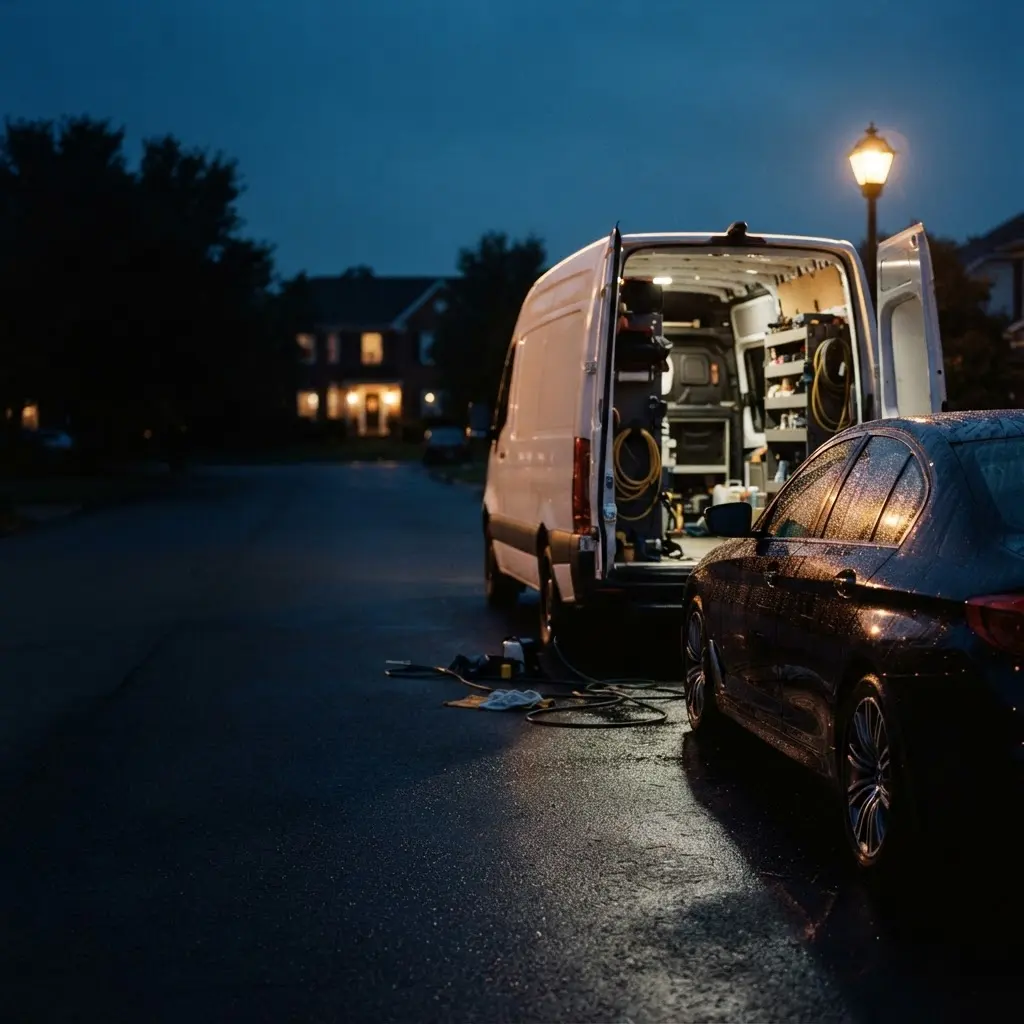
Mobile Detailing Marketing Built Around Your Packages and Your Photos
Mobile detailing marketing has one job: bring in the work a detailer wants, in the towns the detailer serves. That means a page for each package, a Google profile that shows real jobs, and steady measurement of which searches turn into calls. This page explains what the campaign does for a mobile detailer. Our proof comes from our mobile mechanic campaigns, which run on the same method, and we say so wherever we use it.
Why mobile detailing is different on Google
Detailing is the most visual trade in local services. A customer often judges the work from photos before reading a sentence, so a detailer's job photos act as evidence. Photos alone do not rank, though. Google also needs accurate service descriptions, a clear service area, steady profile activity and a website it can read.
A mobile detailer works at the customer's driveway or workplace, which makes it a service-area business. The profile is verified at a real address, the address is hidden from the public listing, and the areas served are listed instead. Google measures distance from the verified address, so the listed towns do not carry the business into other towns on their own. Pages on the website do that. Our guide to Google Maps ranking factors covers the mechanism.
Detailing customers also vary more than customers in most trades. Someone booking a maintenance wash and someone researching paint correction and a protective coating are looking for different things, at different price points, over different lengths of time. One services page blurs them together. Separate pages let each customer find an answer written for them.
The searches a detailer needs to be found for
The searches people make in this trade fall into three groups, and each calls for a different asset.
| Kind of search | What the customer wants | What answers it |
|---|---|---|
| A package named in plain words: exterior wash, interior detail, full detail | To know what is included and whether the detailer comes to them | A page for each package, with real photos |
| A research search: ceramic coating, paint correction | Durability, preparation, process and what the work involves | A longer page for each high-involvement service |
| A service plus a town | A detailer who works in their area | A page for each town served |
| Fleet or business work | A recurring arrangement | A page written for commercial customers, where the detailer takes that work |
We build only the pages for services the detailer really performs. A page that implies a service the business does not offer produces calls it cannot serve and reviews it does not want.
The packages and services a detailer is searched for
A detailer's menu is wider than most customers realize, and each item draws a different searcher. The everyday entries are the exterior wash, the interior detail and the full detail that combines them. Around them sit the higher-involvement services, such as paint correction and ceramic coating, and the smaller ones that people search for by problem: pet hair, a stain, an odor, hazy headlights. Some detailers also take recurring maintenance washes, and some take fleet or business vehicles. Which of these belong on the site depends on what the detailer really offers and wants more of.
The searches follow the same split. A person who needs a clean car this week searches the package name and a town. A person weighing a coating searches the service name and reads for days. A fleet manager searches for a vendor, not a package. Because each of those customers wants a different answer, we give the high-involvement services their own longer pages, keep the everyday packages clear and photographed, and write the commercial page only where the detailer wants that work. Mentioning a service the business will not perform only fills the calendar with the wrong jobs.
The page set we would build
The page set starts with the home page, then one page for each package or service, one page for each town the detailer serves, and combination pages of a service and a town where search data shows people are looking. We add an FAQ page and a gallery, and a library of articles. Each page owns one search, which keeps two pages from competing for the same customer. The local SEO websites service describes the build, and our guide to website structure and depth explains why each page owns one search.
The questions a mobile customer asks are specific to the trade. They want to know whether the detailer needs water or power at the location, how long the job takes, what is included in each package, which areas the detailer covers and how booking works. We answer those on the page where a customer would ask them, in 40 to 60 words with one real fact each. The questions come from the business's own Search Console history, Google's autocomplete and real customer reviews, not from guesses.
Town pages are built only for towns the business genuinely serves, and each carries something that could not exist on a sibling page: a job photo from that town, a customer review that mentions it or a first-hand local fact. Google's spam policies describe pages created to rank for similar searches that lead to a less useful destination as doorway abuse, and a page that exists to help a customer in that town is on the right side of that line.
The profile work
The profile carries the visual proof. We choose the primary category from Google's list based on how customers describe the work, add additional categories only for work the detailer does, and keep the services list, hours, attributes and description current. The services list matches the pages on the website. In one pass across three client profiles we added 36 service entries this way.
Photos are where detailing differs most from other trades. A new real job photo goes onto the profile every day, checked and described before it is published, and never repeated. Before-and-after pairs from real jobs show the result a package produces. Whitespark's 2026 survey ranks photo and video quality 45th among local pack factors, so we treat photos mainly as a way to win the customer who is comparing detailers, and the services list and categories as the way to be shown to that customer in the first place.
Each month the profile also gets 4 posts of 25 to 60 words, each about a service that has its own page and carrying a button for the call or link. Posts rank very low in the same survey, so they exist to convert. We write a reply for every new review, naming the service and the town naturally, and the owner posts it. We never ask customers for reviews on a client's behalf and never buy or incentivize them. The Google Business Profile service and the review service explain each part.
How the profile is built, in order
For a detailer, the profile is built so that the first screen a customer sees already shows the work. We start with the verified address and the decision to hide it, since a mobile detailer rarely welcomes customers there. Then we choose the category from Google's list, write the services list so each package appears by the name customers use, and set the hours the detailer can honestly keep. The description names the packages and the towns in plain words, and the website link goes to the page that matches. Photo habits come last and run through everything: a library organized by service, so that a coating photo sits with the coating page and an interior reset sits with the interior page.
Booking details are part of the profile work too. Whether the detailer needs water or power at the customer's location, how far ahead the calendar is open and how to request a time all belong on the page and in the profile description, in the words a customer would use.
What the monthly work includes
Each month, each business gets 8 off-site articles and 2 on-site articles of 800 words or more. For a detailer, each is written from a real job, such as an interior reset or a coating application, and aimed at a search that real customers make. It also gets 4 Google Business Profile posts, a new job photo every day and a written reply for every new review.
We keep the profile current, update the website from real searches and the data in Google Analytics and Search Console, check map positions weekly from a grid of nine points around the verified location, and deliver a monthly report built from Google's own numbers. The content publishing service explains how article topics are chosen.
Every campaign is tailored to the individual business and adjusted month by month as the data comes in. A detailer who sells mostly maintenance washes needs a different page set than one who sells mostly coatings, and the data shows which one applies.
What the same method has produced
The measured results behind this method come from our mobile mechanic campaigns, which use the same approach: a page for each service, a profile kept current and monthly adjustment from search data. Each figure is dated. The mobile mechanic marketing page shows the campaign those results come from.
Backyard Mobile Repair in St Paul, Minnesota saw its monthly Google profile actions rise from 93 in March 2026 to 252 in October 2026, website clicks from the profile rise from 1 to 137, and messages rise from 0 to 21. Read the Minnesota case study.
DFW Mobile Auto Mechanic Pros in Fort Worth, Texas averaged position 3.6 in regular Google results for "mobile mechanic dfw" from July to October 2026. Read the Texas case study.
Any Hour Mobile Mechanic in Plano, Texas recorded 224 calls from its profile in August 2026, its highest month on record. Read the Plano case study.
Results depend on the market and on Google, and we promise no ranking or revenue. We promise the work described above, measured every week and reported every month.
The business side of mobile detailing
Marketing fills the calendar, and the business side decides whether a full calendar pays. Working with us includes advice on that part, because we see the search demand, the call and message volume and the competitors in each market every month, and we work only with this kind of business. It is advice and not a promise, and every decision stays with the owner.
Pricing structure comes first, and in detailing it has more moving parts than most trades. A detailer decides how packages scale with the size of the vehicle, which add-ons are sold separately, whether a travel charge applies beyond a certain distance and whether a minimum applies to a small job. The higher-involvement work, such as a coating, may be quoted after the customer has described the car and its condition, while a maintenance wash may carry a fixed price. Publishing a price gets the customer who is comparing packages, and quoting on request protects the detailer who cannot price a job unseen. Each choice is a trade-off, and our advice on pricing your services and the guide on how to price mobile service work cover how to weigh them.
Capacity is the next decision. A detailer works one vehicle at a time, so the limit on the calendar is plain to see. As an example, labelled as an illustration and not a client result, a detailer who is booked well ahead and sending customers elsewhere could add a second van and a second detailer, or could add help with scheduling and customer messages so that the one detailer spends the day on cars. We help owners read their own booking and message volume to tell which is the real limit. See the advice on hiring and growing a team and the guide on when to hire your first technician.
Service area and hours are the last. Detailing is driven by travel between customers, so a tight set of towns often earns more than a wide one, and weekend and evening availability matters because many customers are at work during the day. Hours shown on the profile should be the hours the detailer will keep. The advice on business model and service area, the business growth advice hub and the guide to the mobile service business model go through it.
Pricing
The Full Package is $325 a month, with no one-time payment and no contract. It includes everything in the monthly work above, along with the website, hosting, the edits you ask for and ongoing profile management, and you keep full ownership and can take everything with you if you ever leave.
The Website Only plan is $200 one time and $50 a month. It gives you a fully built-out, optimized website that you approve before it goes live, hosting, the edits and updates you ask for and a free one-time optimization of your Google Business Profile. We promise no ranking and no revenue. The pricing page shows what each plan includes, and the local SEO websites service describes the build.
Related reading
Next step
A free 1 on 1 marketing consultation is a free, one on one conversation with us about your marketing, where we look at your Google listing, your website and your local market together and lay out what we would do. You can bring your packages, your prices and your plans for the calendar, and we will talk through all of it. See also the Minnesota case study.
Call or text us at (712) 251-1967.
Email us at garinfroehlich37@gmail.com.
FAQ
Yes, if you apply coatings. A customer researching a coating compares options over days and wants to know about preparation, process and what the work involves. A dedicated page answers that research directly, while a coating buried inside a general services page answers it only in passing. We build one page per service you actually perform.
They help customers choose you more than they help you rank. Whitespark's 2026 survey ranks photo and video quality 45th among local pack factors, well below the primary category and the services list. We upload a new real job photo to your profile every day because a customer comparing detailers wants to see finished work.
The service-area list on the profile does not do it. Sterling Sky's test found the list does not currently affect ranking for service-area businesses. Pages on the website do: one for each town you genuinely serve, each carrying a job photo, a review or a local fact that belongs only to that town.
We start from your real jobs and from Search Console, which shows the searches that bring impressions with no page answering them. Each article is aimed at one real search, with the service and the town named naturally. A variety rule keeps the same service from repeating in consecutive posts, and we adjust the topics each month as the data changes.